|
|
Guy Fiero - The Cooling System |
Pick One:
|
|
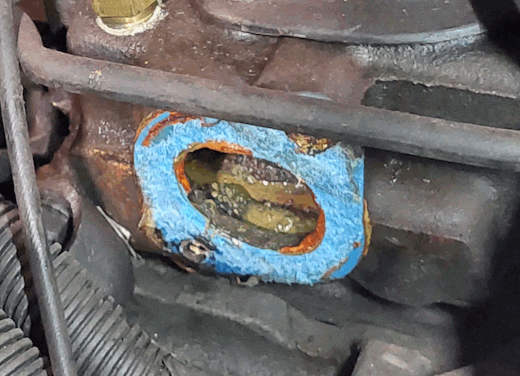
Oh God The Cooling System Remember when I had to pull the heater core? As a result of that, I obviously had to top up the coolant again. Taking off the coolant fill cap, I noticed that it looked a little grimy, so I decided to take a closer look. Big Mistake.
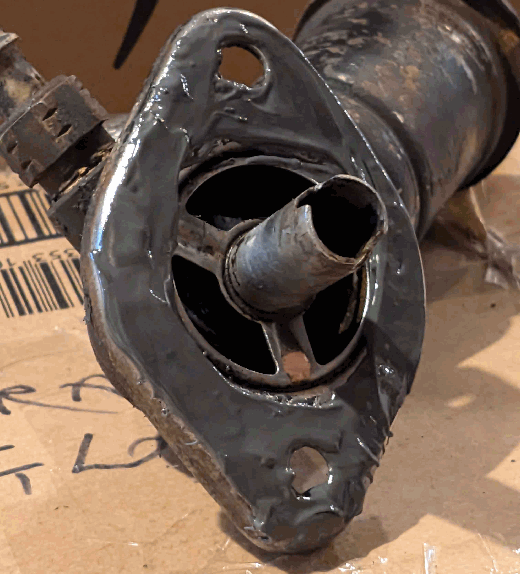
WHAT IN THE LORD'S NAME IS THAT As far as I can tell, the most likely story is that our good mechanic buddy decided that instead of running coolant, he would run hydrochloric acid. Whatever, how do we fix this. Obviously the entire cooling system needs to be flushed, many times. The thermostat housing also needs a complete refurbish, since it's covered in rust. Naturally, I got right to work. Alright, I procrastinated for a while then I got right to work. Using a bench grinder with a wire wheel attachment I knocked back the rust on the outside of the thermostat housing, then used a brass brush to give the inside the best chances of survival. Using a new paper gasket from The Fiero Store, I glued the hell out of both mating surfaces with RTV, stuck them together, then spent the next two hours fighting to get the lower bolt installed. At least it was finally done. For the coolant flush, I went down to the auto parts store and decided that I would try to improve my chances of success by investing in a dedicated "coolant flush" solution. It's a small bottle that you dump in alongside the water, but for the $13 I paid it had better pack a pretty good punch. So the day has arrived. I dumped in my entire bottle of coolant flush, filled the system with water until it wouldn't take anymore, and started the engine Immediately things go south Coolant is gushing out of the thermostat housing. Coolant spilling isn't necessarily a problem, since I hadn't put the cap back on yet. What is a problem is that putting the cap back on didn't make it stop. I managed about a minute of "flushing" before having to kill the engine. Casualties included my now shattered "no coolant spilled on the shop floor" record, my sanity, and worst of all, my entire $13 bottle of coolant flush that went into stripping the floor of all oils and contaminants. This is what broke me. I pulled the thermostat housing back off, reapplied the RTV with no gasket now, threw everything back together, and left it to cure. Then we proceeded to get hit with the biggest snowstorm of the season, with temperatures in the negatives for the foreseeable future. Unfortunately, this kills any coolant flushing plans, as the process heavily depends on the assumption that the water will not freeze. Months go by, and I do not touch the car. It's much too cold, and I'm much too downtrodden to even think about tinkering with this damn thermostat housing. But eventually, the weather warms up, and I'm feeling renewed. The RTV I put on several months ago is most likely cured by now, so I decided to take another crack at flushing the cooling system. I bought another $13 bottle of coolant flush since I was quite impressed with what it managed to do with just a minute of flushing (though smartly, I did not dump it into the cooling system just yet). I topped the cooling system back up with water, and started the engine. At the very least, it wasn't gushing coolant anymore, but it was still dripping. Dammit. At this point, I decided to formulate a new angle of attack. Clearly, there's something wrong with the thermostat housing for it to keep leaking. On the Fiero, the surface where the thermostat housing mates to the engine is notorious for warping, causing a bad seal. The idea is to apply JB weld to the sealing surface to add some material back, then sand it completely flat. This should create a new sealing surface that's much stronger than RTV just trying its best. If you know what this part actually looks like then you might already know where this is going, but for the uninitiated:
This is the Fiero thermostat housing. Astute observers may notice the giant metal rod sticking through the middle of it, and may have even realized how difficult this will make sanding. Because of this, I would be forced to sand the part in 4 separate sections, and get them all level via magic. However, I was undeterred. I applied the hell out of that JB weld, allowed it to cure, and got to sanding. This was a terrible mistake. As it turns out, it actually is quite difficult to sand something level when you're doing in in separate sections, and before long I had burned through the JB weld that I had built up. This broke me. At this point, something snapped inside me. My mentality quickly switched from "make it seal" to "MAKE it seal". So, what do you do when you can't level your JB weld? You make it level itself. I quickly formed a horrid, terrible plan. I would JB weld the gasket directly to the thermostat housing. Immediately this raises alarm bells, but the idea isn't completely insane. Think about it: We know that the sealing surface on the engine is perfectly flat, while the thermostat housing is warped. If I apply JB weld to the thermostat housing, add the gasket, then mount the whole thing to the engine, the JB weld should automatically level itself, and leave me with a flat sealing surface. The only major issue that I could think of was the potential of too much squeeze-out. If I fully mount the thermostat housing with the JB weld still uncured, it's possible that there won't be enough pressure applied to the sealing surface to actually make a good seal. I decided to tackle this issue by simply not fully mounting the thermostat housing. What I did was apply the JB weld, apply the gasket, then I mounted the part to the engine without the bolts, then took it off again. Theoretically, this should create a flat sealing surface without introducing the full pressure that the part will be under when installed, preventing excessive squeeze-out. Now obviously, to any man who hasn't been slowly beaten down over the course of months by this car, this sounds absolutely insane. But you know what? It totally did not work. At this point, I give up. I am most certainly not fixing this original thermostat housing, so my best bet is to try and find a replacement. This is much easier said than done, but hopefully some Fiero guy somewhere has just wrapped up a 3800SC swap and has some parts to spare. Unfortunately, I did not have as much luck with this as I hoped I would. I made a post on the Fiero forum asking for a 2.5L thermostat housing, but received no reply for about a week. But then, the unthinkable happened. I received a reply. It was not somebody with a thermostat housing, but they suggested that I contact a guy named Larry. Given that I had no other leads, I sent an e-mail to Mr. Larry and waited for a reply. He actually responded quite quickly, and explained that unfortunately he only carries 2.8L V6 parts. Despite not being able to supply the part, he pointed me towards two people in particular. The first guy only had Facebook Messenger, and since I'm banned from Facebook I quickly turned to the second guy, Pat. Pat also responded quickly, and didn't even immediately deny my request, which was encouraging. He said he would check his wares after getting home from an event, then in another e-mail separate from our chain, sent unsolicited Fiero pics. Naturally, I responded with my own, but communication died off shortly after. He must not have liked the car. Out of options and desperate for some sort of resolution, I knew what I had to do. So I started googling the other guy Larry mentioned, Todd. Creepy? Maybe. However, you need to understand the situation I was in here. My stalkingness did not go unrewarded either, as I learned that Todd actually runs a Fiero shop of his own, which had a contact e-mail. I sent Todd an e-mail, and he responded very quickly with a price and the selection of parts that I could choose from. The options weren't fantastic but I was sure at least one of them would be workable. They were all a later variant of the thermostat housing that doesn't have the warping problem, so my main concern was finding one with minimal corrosion. I examined the images closely, and picked the part that I thought had the least corrosion on the inside. While I was here, I also asked if he could scavenge a valve cover bolt, because ages ago I had dropped one of mine and never managed to recover it, which surely won't be an issue at some point. He quickly got back to me with photos of the part I had chosen, as well as the bolt. He didn't even charge me for the bolt. What a class act. Then he tried to get me to join a Fiero cult for $30 a year, which was tempting but I decided to hold off. (To be clear, I've amped up certain parts of the story here for comedic effect, but in reality everyone was incredibly helpful and enjoyable to talk to) Eventually the new part arrived, along with the new gasket that I ordered from RockAuto. The thermostat housing wasn't in fantastic shape, just about every sealing surface was rusty and the coating on the inside was chipping apart. This one got the same wire wheel treatment as the last one, in addition to drowning the inside with brake cleaner to try and do something about the chipping. We'll be doing a coolant flush anyways, so this isn't a huge deal. What is a big deal is the gasket that I ordered. You see, something really funny happened: it's the wrong one. I knew going in that the ancient scriptures (threads on the Fiero forum) foretold that they did not make new gaskets for this style of thermostat housing, but I had hoped that since then things had changed. They had not. So if you can't buy a gasket, what about making one? Unfortunately, the thermostat housing takes an unusually thick gasket, so most standard packs of gasket material will not work. Knowing this, I opted to pick up a 4 piece assortment pack from Felpro. The rubber and paper options in the pack were much too thin, but the cork options included seemed to have a chance. The thinner of the two seemed a bit too thin to seal, but the thicker one was so obnoxiously thick that I was hesitant to use it. I figured I would give the thin option a try first, just to be safe. I cut a decently fitting gasket out of the sheet using definitely the wrong method, and threw the thermostat housing on the car in record time. Turns out, after the 5th time you start to get real good at this. Unfortunately, the thin gasket was simply not up for the task. It started leaking before I even started the engine. In a fit of rage, I decided fuck it and cut a new gasket using the thick cork, with the old one as a template. This gasket was so incredibly thick that I was worried the part wouldn't sit flush against the engine, but as I tightened the bolt it actually seated properly. Not only that, but it didn't leak when I topped the system up. Time for the real test. I got in, turned the key, and started the engine. The engine ran horribly, because the later thermostat housing has a temperature sensor with a different connector from the original 84 one, so the ECM had no idea how hot the engine was. But it did not leak. I didn't run the engine for too long because it was sounding particularly grumpy, but I wasn't able to see a single drop from the thermostat housing. Even the cap seemed to seal, which is a common failure on these. So the next order of business is to swap the new connector onto the wiring harness. I was always going to do this anyways because the original had cracked wires, but now I kinda have to. This was pretty straightforward. I cut the old connector off, tinned the leads, soldered the new connector to the wiring harness, and covered it in some heatshrink to top it off. The engine was much happier after this, so I decided to take it for some victory laps around the driveway to let it get up to temp, as well as to sort out a couple small issues, like the upshift light. Everything went smoothly, meaning the car is finally mechanically stable enough to drive! The car may be drivable, but I have needs too, you know. The biggest need is a functional radio, so that needs to be sorted.
|
|